Introduction
Modern life is heavy with noise: inequality, isolation, violence, a planet in decline. Technology spreads it all instantly, until fear and doubt feel like the default condition of being alive.
Crushed by consumerism and the pressure to survive, people feel threatened by their own kind: disoriented, betrayed by the systems meant to protect them. They no longer really communicate, or laugh. They numb themselves; with screens, with medication, with a scroll that mimics connection but isn’t. The tools built to save us time have turned against us, draining what’s alive in us.
“Societies are methodically erasing emotion — and with it, humanity itself. Consciousness is mechanized at the push of a button. Man becomes a wound-up machine… hope dies in modern societies.”
And yet, this can change. We were not made for this. We were made for nature, for freedom, for one another. From the beginning, we built bonds because we knew we grow through community: institutions, art, language, and through them, emotion itself, our most powerful tool. What separates us from animals is the ability to question, to imagine, to keep creating ourselves. But the pace of change today has grown so fast it makes us doubt our own existence.
“There is something worse than a cataclysmic war: the transfer of power to the machine. We are asleep — and it is our responsibility to wake up.”
It’s time for the frenzy of unchecked growth to stop. Let the noise settle, so quiet can return. The world is full of wonders, but our minds are too full of noise to hear the call of life and love. In silence, even birdsong and the whisper of pine branches can speak to us.
We must make room again for feeling: for love, above all. In a world obsessed with the self, love has become something people fear rather than trust. The heart, once the truest symbol of love, is now mostly an emoji, invoked from a distance, stripped of real contact.
Society is not separate from us: it is made of each of us. Every person who changes from within changes the world.
"Let me not forget
the people around me;
and my own humanity."
The Concept
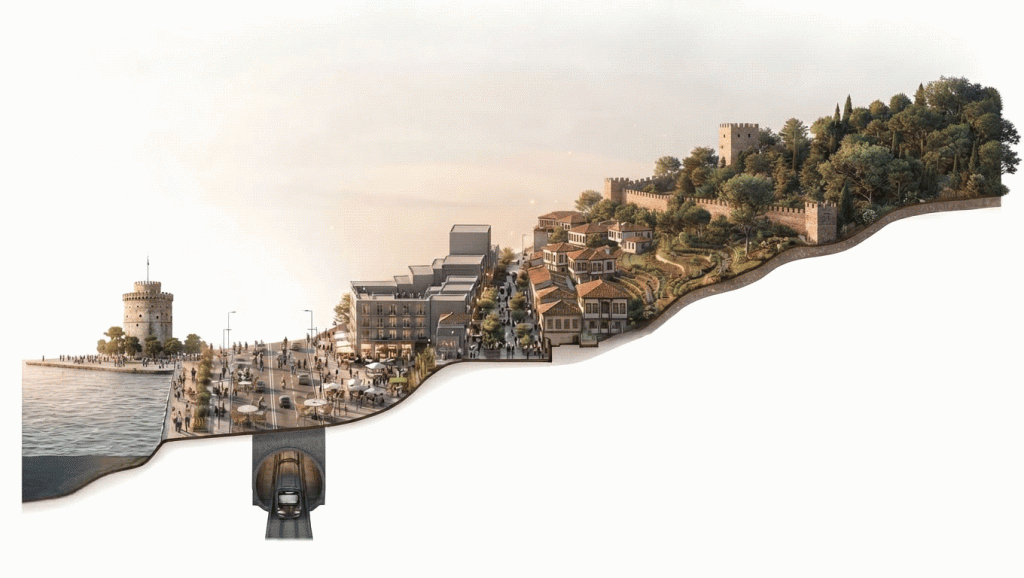
Thessaloniki (GR) never stops. It rushes, it hums, it collides with itself at every corner — and it is here, in the heart of that motion, that Naturartscape chooses to begin.
We believe that even the busiest cities hide pockets of stillness, waiting to be found. Naturartscape exists to uncover them, carving peaceful pathways through the forests, parks, and green spaces that already surround us, turning overlooked corners into sanctuaries for the mind.
Art walks beside nature on these paths. A sculpture glimpsed between the trees. An installation that stops you mid-step. Not spectacle, but invitation; small provocations that pull you inward, toward a quieter, more honest encounter with yourself.
Leaving the noise and chaos of Thessaloniki behind, each visitor sets out on a personal journey of self-discovery through nature. Along the way, six thematic stations mark the path; each one an invitation to pause, engage, and reflect, transforming the walk into an experience, and making the distance feel less like a journey and more like a discovery.
And yet, no one walks these paths alone. Strangers become neighbors. Silence becomes shared. Naturartscape builds spaces where community takes root, not through noise, but through presence.
We are not adding to the city. We are revealing what was always beneath it: calm, creativity, connection; hiding in plain sight.
It starts in Thessaloniki. It won’t end there.
The Masterplan
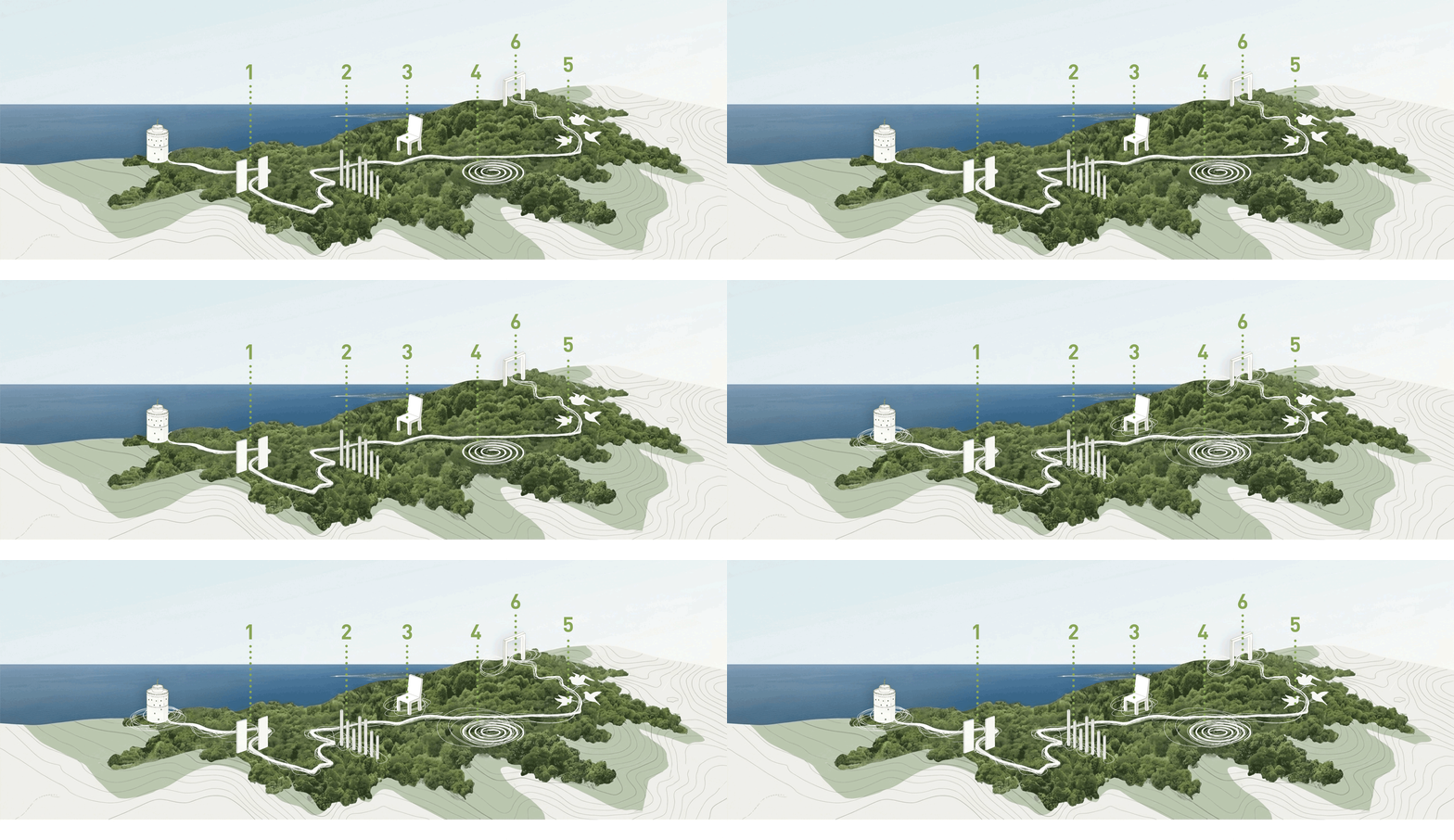
Station 1
The Unknown
Follow your heart! and the path it shows you! Don’t let your heart do the judging. Your mind is what should judge. The heart advises the mind, not the mind the heart. The mind thinks, the heart feels. Look very far away or very close; very high or very low; very deep or very superficial; in complex ways or simple ones. Move! When you move, things happen. Miracles search to find you, and they won’t find you if you’re locked away. You must move toward them so they can locate you. The direction doesn’t matter; what matters is that you move; and if you make a mistake, a mistake is nothing more than a misguided, foolish observation. Later you will discover that even the mistake happened for the good. Don’t be afraid! The only active enemy is fear, because it is an ally of inertia.
At first, the journey of exploring the unknown may seem solitary, but once the steps begin, one realizes the journey is not solitary at all. It is participation in a relay race. Each step leads to the next, and there someone else is waiting (someone who follows, or someone who is followed). And each person searches in the time and place that belongs to them, wherever and whenever, in whatever way they can, with whatever they know, however they wish; in the small or the great, in little or in much, secretly or openly, with freedom and independence, with dreaming, with understanding and reflection, with courage and daring, with love and devotion. There are no insurmountable obstacles, no disappointment, no small-minded self-interest, no mockery, no hesitation or fear, no weakness or ignorance, no ulterior motive. There is nothing else beyond the fulfillment of one’s longings, with ever more and better means.
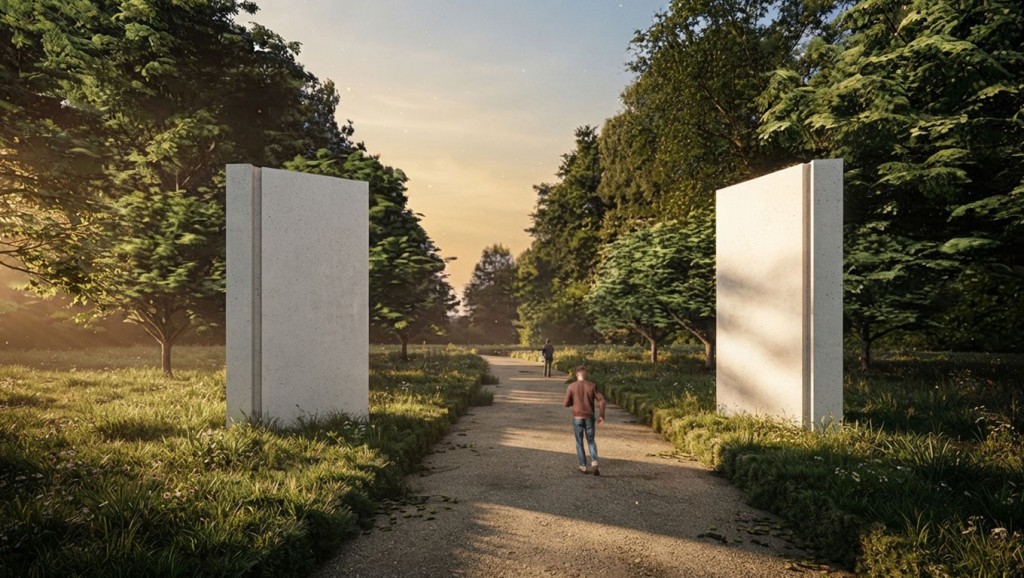
The path begins with a large door representing the Unknown, which in the multidimensional mind of humankind, is identified with exploration. The whole titanic, multifaceted, singular, and timeless adventure of all people (the adventure that justifies the very existence of humanity) was accomplished with only one common, pure, and clear intention: the exploration of the Unknown. It doesn’t matter how this is understood, or what dimension or meaning it holds; it doesn’t matter how it is absorbed or believed. What matters is that behind all of it, the message is shared. Through the effort of exploration we can reach fulfillment and improvement. This is the lofty mission of the human being, who is not a machine or an animal, but a spiritual entity.
“Remember that on every journey, it is the journey itself that has value!”
Station 2
The Fear
Fear nothing!
Don’t be afraid of doing something foolish. You will be judged by people who will themselves be judged by their own foolishness. Just do what you believe is good. As long as you remain open, willing to learn from your own actions, none of your actions will be foolish; because it will have contributed to wisdom…
Don’t fear the opinion of others. If they are suspicious by nature, they will suspect you no matter what you do; if they are mocking, they will mock you no matter what you do; if they disagree with what you say, they will turn against you no matter what you tell them; you cannot convince them. Do what you want, and don’t be troubled by it: actions remain, while the words that criticize them fade away…
Don’t fear danger. Nothing was ever achieved without risk, without daring, without uncertainty and insecurity… Don’t fear the Unknown. It doesn’t necessarily hide something terrible; it might hide something wonderful…
Live your life! Do the things you dream of. Now. The method doesn’t matter. Just do them. You must bring your ideas to birth in reality, in the physical world… pull them out of the world of ideas and dreams. Yesterday’s dream is today’s truth. Shoot all your arrows at the target; don’t hesitate. Never lose hope over anything. The universe may stop its endless orbit and take everything from us. But there is one thing no one can ever take from us: Hope!
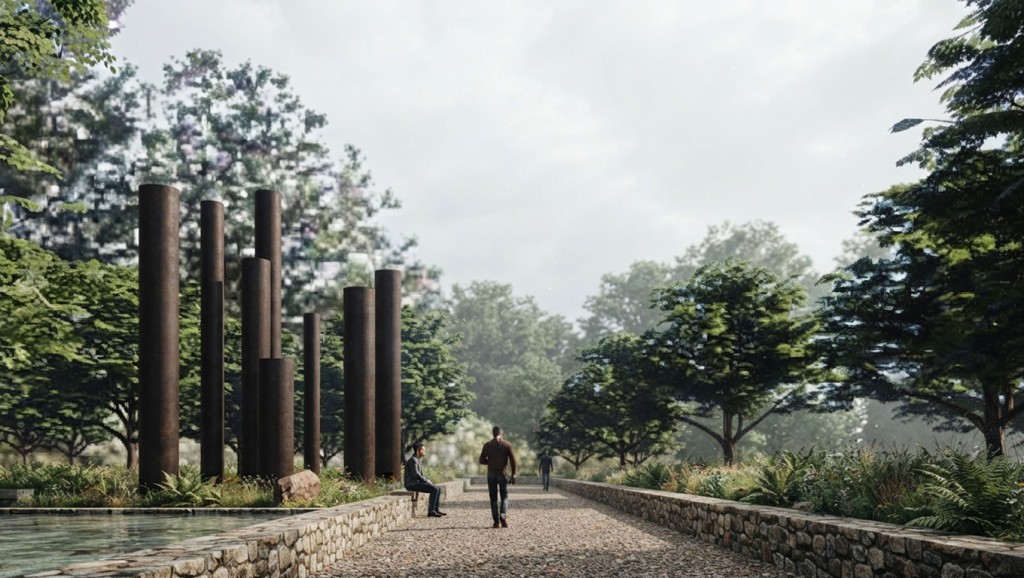
With a composition of tall vertical cylinders and a rock in the middle of their base, the Fear which is represented as the topic of the second stop of the path. Fear is a concept and a trick of the mind, and is nothing more than the uncontrolled ego and the paranoia of the mind. It can be as feeling a small hesitation or a tremendous terror, as the shape of the shades changes under the light of the day. It is a human invention, applied to control the masses for social and commercial purposes; and so fear can never be greater than the one who created it. Therefore, a person sitting on the rock has the ability to limit himself through fear, and therefore a person decides for himself how far he wants to go or which perspective of the shades wants to follow…
Station 3
Materialism, Megalomania
The hysterical materialism that grips modern life is a tendency born from rapid technological growth and fueled by capitalism. Guided by the laws of the market, material prosperity risks becoming an end in itself, constantly inventing new artificial needs that impoverish societies and dull the senses.
Consumerism, amplified by globalization, treats people as tools of the market and makes money the dominant value. As societies build themselves around manufactured needs, they lose their own vitality; wealth concentrates further among the few, while inequality shows no sign of narrowing. This same hysteria corrupts knowledge itself, since its uses are dictated by those who hold economic power. Social norms bend to money, and the defining question of the age becomes how power is won, lost, or shared among the powerful. From this comes a belief that only wealth brings freedom, control, and security; leaving fewer people who gain power and remain humble, and fewer still who, having much, actually feel content.
Perhaps we had to take our way of life this far, to this extreme, before we could see that happiness and balance were never in more; they were always in the simplicity nature already offers.
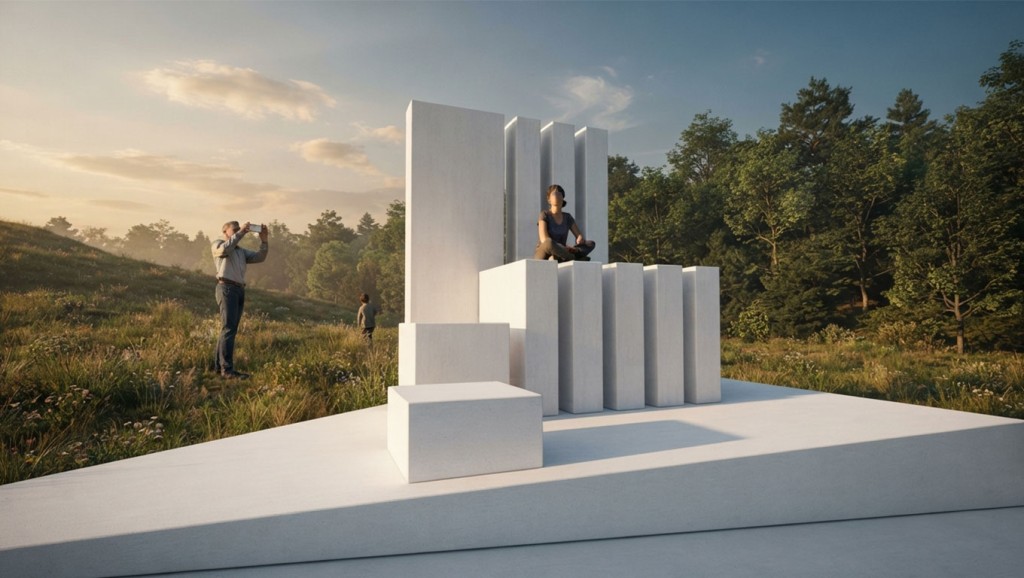
An oversized chair, jarring against the beauty of the landscape, makes the person beside it (or on it) look small. Its position is intentional: from here, a visitor can sit and take in the calm of the natural world: the green of the trees, the blue of sea and sky. This imbalance was deliberately placed here to be seen.
Station 4
The Inner Battle and the Dialogue of the Soul
In a world moving at a frantic pace, the fourth station serves as a vital sanctuary for pause. It invites humanity to step away from the noise of modern life and reflect on its evolutionary journey. Under the gentle, grounding influence of the natural world, visitors are gently guided to confront their inner battles.
This space is designed to strip away the distractions of daily life, encouraging them to look inward, acknowledge their imbalances, and begin a profound, healing conversation with their true self. Wisdom is not found in isolation.
This station is also a catalyst for authentic human connection. Here, individual reflection opens the door to genuine dialogue with others. In this shared space, visitors are invited to shed their armor; to listen deeply, speak with vulnerability, and truly attune themselves to the presence of fellow travelers.
By shifting focus from material wealth to human presence, we remember that true happiness is born from the light of meaningful connection.
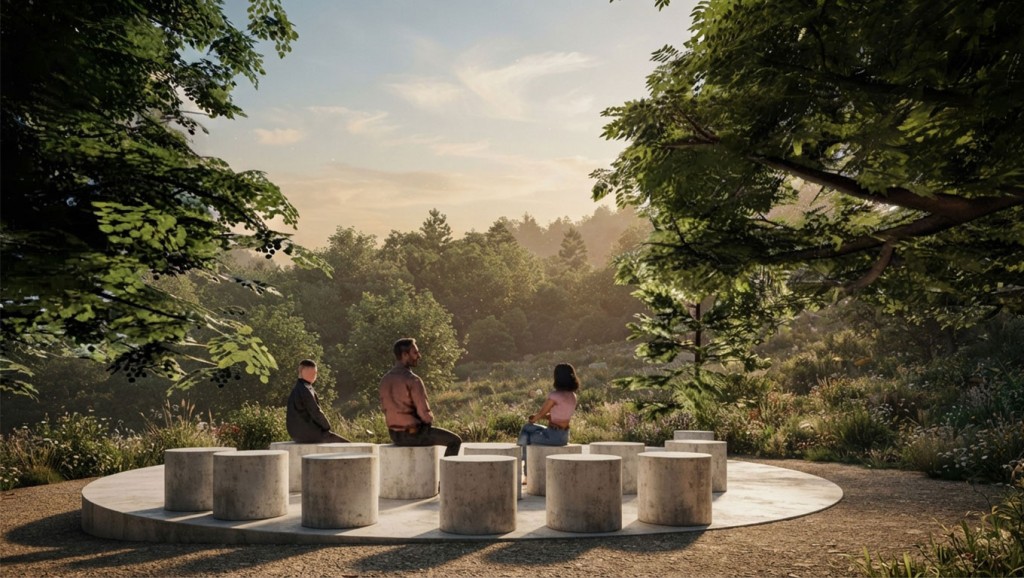
The amphitheater stands as a powerful testament to the relationship between humanity, art, and the cosmos. Traditionally a place where dramas unfold, this circular structure transforms the natural landscape into a living stage. By placing the viewer on the seats and nature itself on the stage, the architecture flips the script on modern consumerism. It serves as a reminder that no material possession can replicate the grandeur of the earth. The open-air, natural materials of the circle symbolize the infinite nature of the soul, locking people that stands there, into an eternal dialogue with the environment and each other.
Station 5
The Garden of Silence
At the fifth station, in a natural clearing where earth and green meet against the sea, a quiet balance takes shape. It sits like a small clearing within a larger one, ringed by trees whose branches filter the space between inside and outside.
Nothing is fully shut out; the eye moves through trunks and branches reaching toward the sky, so what lies beyond still finds its way in. There is no sharp line between this space and the world outside, only a quiet flow between them, built from silence itself, and the sound silence makes in nature.
The garden of silence is not only something to see and touch, but something to hear; alive with the music of the natural world. And it is also a shared, intimate space: an open-air classroom where visitors become students of nature, drawn closer to it, and prepared, from within, to receive the Light.
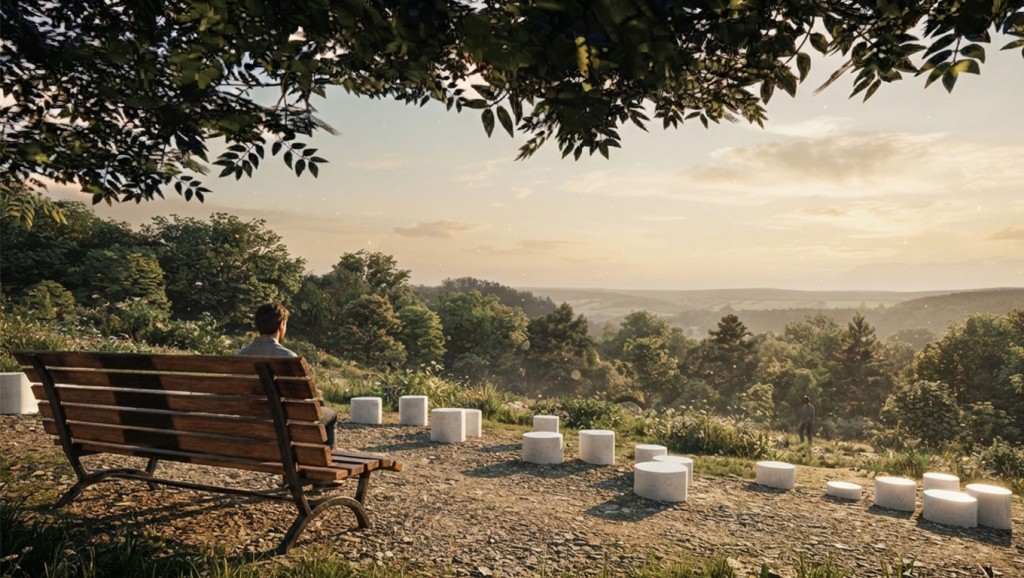
Simple seating made of natural materials, scattered without order, creates a space where people and nature meet in a wordless exchange: They care for and protect what grows here, and in return, nature offers them the images, sounds, and feelings that sustain our inner well-being.
This is the garden of silence: a refuge from the noise and rush of city life; a place to sit, to rest, to simply be; to do the small, ordinary things that modern life so often makes impossible.
Final Station
The Light
Light — whether blazing from the sun, flickering from distant stars, bursting from fireworks, glimmering from a firefly, or simply cast as shadow and reflection — has always been vital to human life. So much so, in fact, that every religion since the dawn of civilization has used it as a symbol.
In Scripture, “Light” even names God himself: “I am the light of the world; whoever follows me will never walk in darkness.” Christ’s words echo in the Creed: “Light of Light, true God of true God.” In antiquity, Hyperion, Apollo, Phaethon, Zeus, and Prometheus were bound to light: Prometheus punished for stealing fire, a secret the gods had guarded. Sacred flames burned at Delphi and among Rome’s Vestal Virgins. Today’s votive candles carry that same flame into Orthodox tradition, just as the Olympic Flame still burns in Apollo’s name every four years.
Spiritually, light has always meant knowledge, truth, justice, paradise; its opposite, darkness, means ignorance, falsehood, ruin. We need only close our eyes a moment to feel how much we depend on it, and how urgently we long to open them again.
This light (precious, intangible, freely given by nature) is what we found in full measure at the end of our path, on the plateau at the hilltop. We grow braver in brightness. To know our own light is to know ourselves, to face our story honestly. That self-knowledge builds confidence; confidence brings peace and clarity; clarity lets us truly connect with others. Connection is the foundation for everything else: one light feeds another. A strong family strengthens those around it. A community bound by purpose can inspire a whole city. This is the power light holds within us.
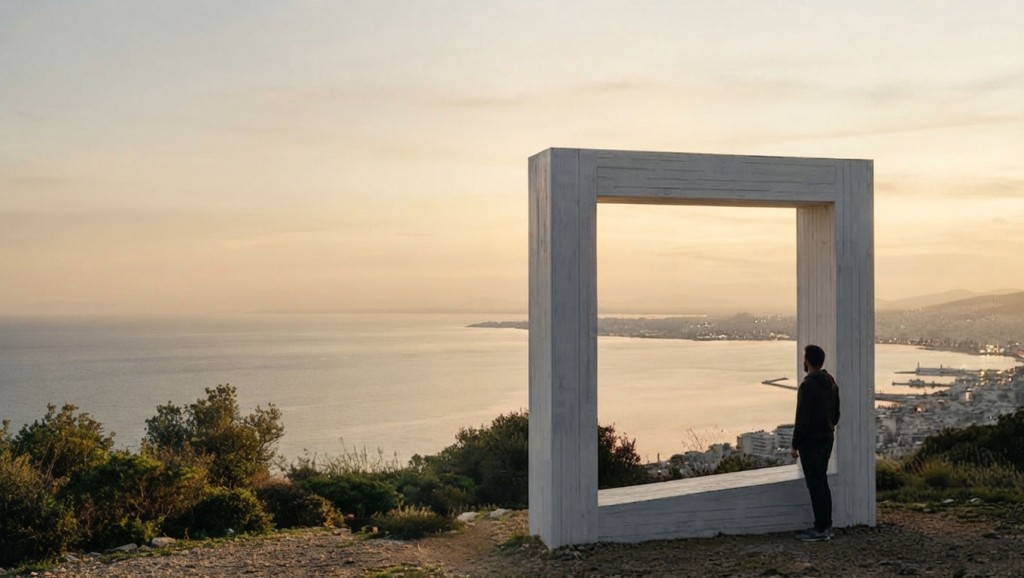
And so it was decided: the final stop, at the top of the climb, would simply be called “LIGHT“: in the hope that every visitor, after a walk shaped by reflection, would find their own. The large, minimalistic frame installed on the hilltop serves as a physical lens for this realization. It does not contain an artwork; instead, it frames reality itself, capturing the vast sky, the horizon, and the panoramic view looking out over Thessaloniki. By isolating a piece of the landscape, the frame prompts the visitor to step into the brightness, face the openness, and carry this clarity home as a lasting memory from the hill’s highest point.
